Transforming an early-stage employee advocacy platform from a simple post-sharing tool into a flexible content distribution system.
Overview
Ambo is an early-stage employee advocacy platform that empowers employees to become brand advocates, enabling companies to share and amplify content through their employees’ personal networks.
When I joined as the Founding Product Designer, Ambo was evolving from a simple post-sharing tool into a richer editorial platform. What began as one post shared by many employees gradually expanded to support content variations, scheduling, reposts, AI-assisted creation, and increasingly sophisticated publishing workflows.
My role: I joined Ambo as the Founding Product Designer, working closely with the founders to shape the product from its early stages.
My responsibilities spanned the entire product lifecycle, from product strategy and UX architecture to interaction design, AI-assisted experiences, design systems, and shipping the final product
The Challenge of Scaling
Every new capability solved a genuine customer problem, but together they fundamentally changed how content was created, managed, and distributed.
The original product had been designed around a much simpler publishing model. As editorial workflows evolved, the assumptions that shaped the initial experience no longer held true. Workflows became fragmented, the information architecture struggled to accommodate richer publishing scenarios, and interaction patterns that had worked well in the product's early stages no longer scaled.
The challenge shifted from adding features to designing an editorial experience that could absorb increasing complexity without passing it on to users.
This evolution focused on four key areas:
- Content Creation: Supporting content variations, reposts, and richer publishing workflows without increasing cognitive load.
- Content Management: Helping teams organise, manage, and monitor content throughout its lifecycle.
- Performance: Connecting content with meaningful insights and campaign outcomes.
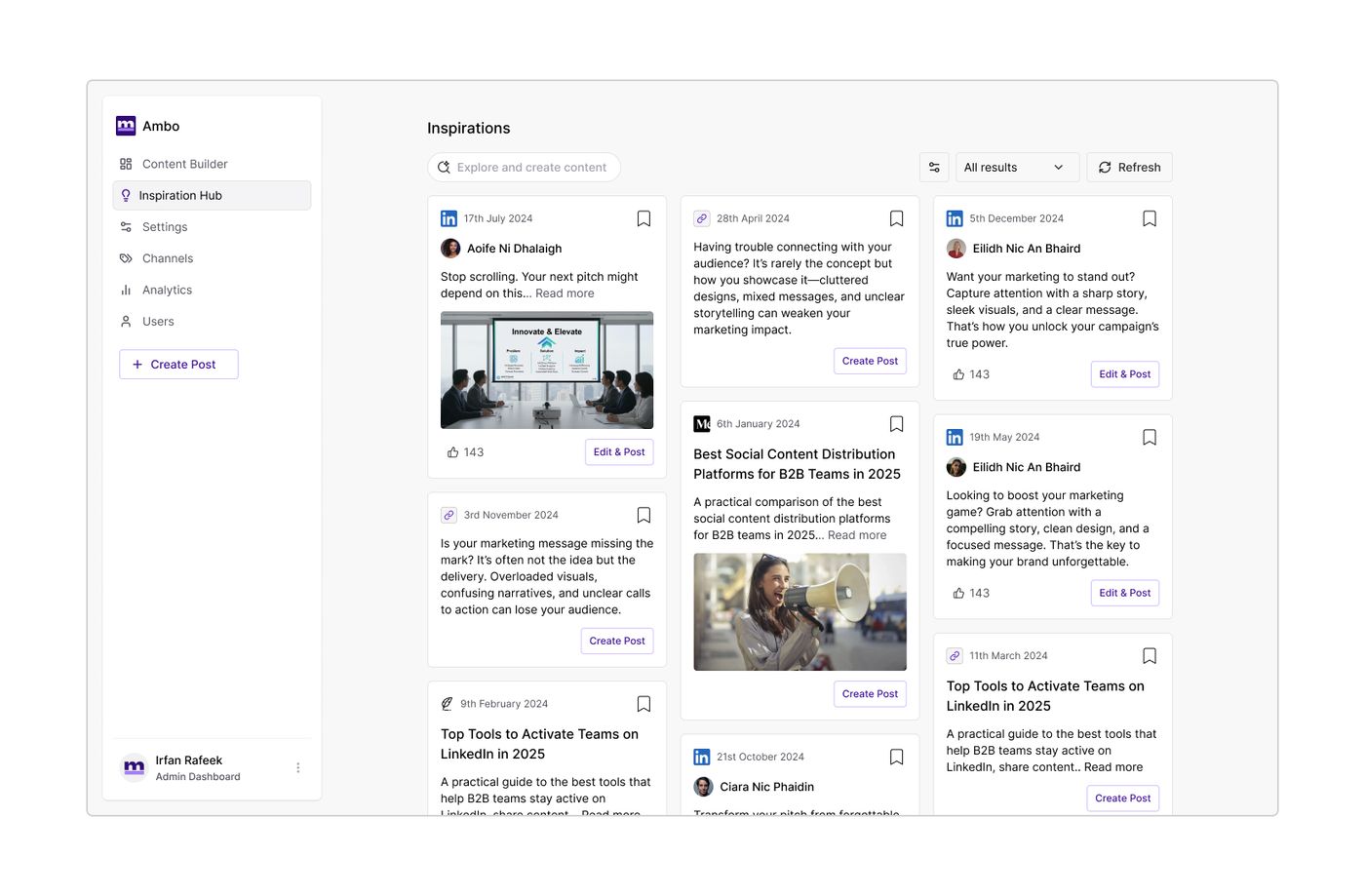
- Content Discovery: Supporting ideation before content was even created.
While my work spanned multiple areas of the product, this case study focuses on the evolution of the editorial experience, where many of Ambo's most interesting workflow and interaction design challenges emerged.
The following sections highlight some of the key decisions that shaped Ambo's editorial experience.
Restructuring Content Creation
The first version of Ambo solved a simple problem.
Marketing teams created one post. Employees shared it. It worked. Until customers wanted more.
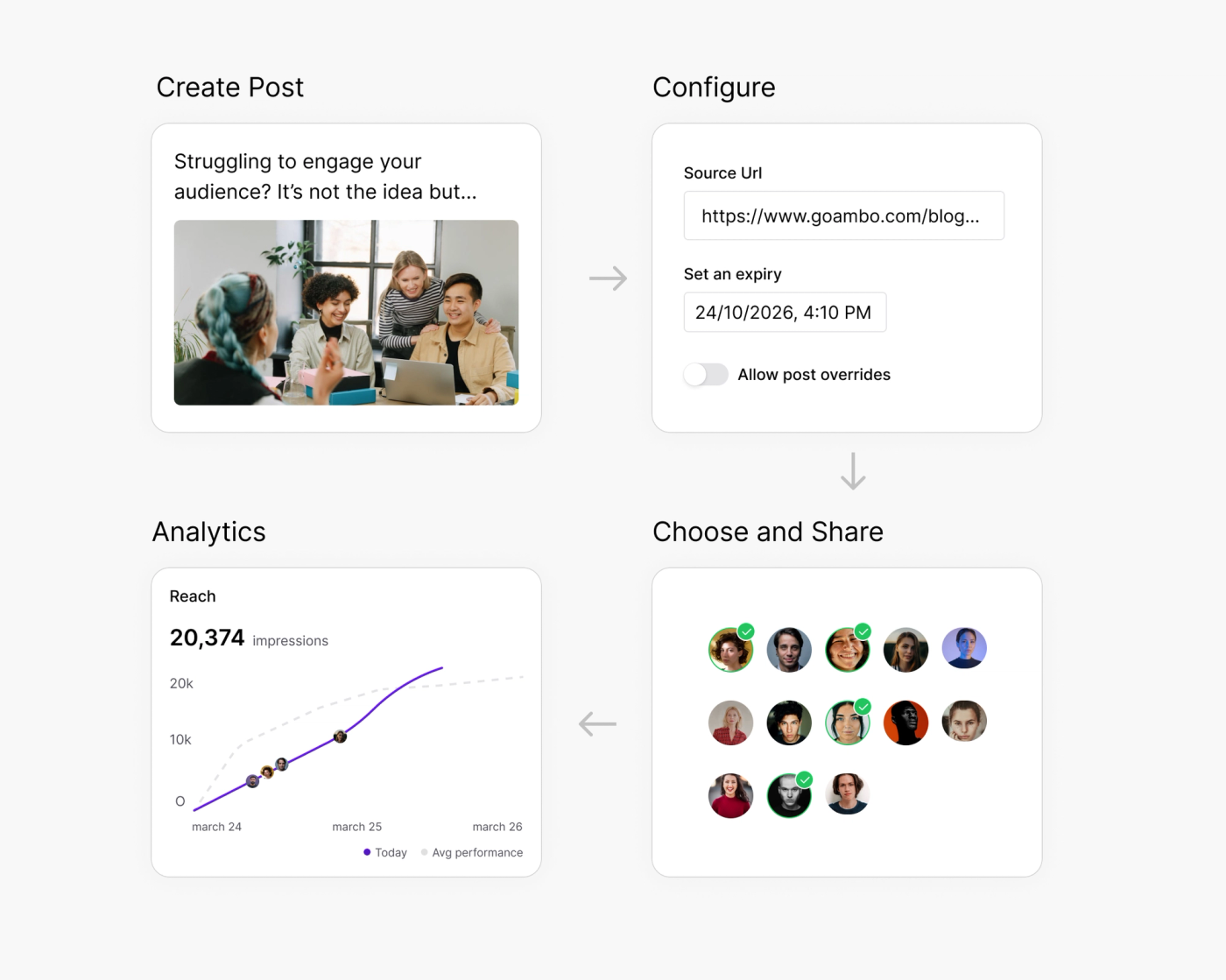
As companies started using the platform at scale, new requests kept emerging. Some wanted different messaging for sales, marketing, product, and leadership. Others wanted posts to be reshared automatically over several days instead of all at once.
Marketing teams wanted to schedule content differently for different employees. Executives wanted content tailored to their own voice. Every request made sense on its own.
Every customer request wasn't just another feature, it fundamentally changed the product's content model.
Where Complexity Started to Appear
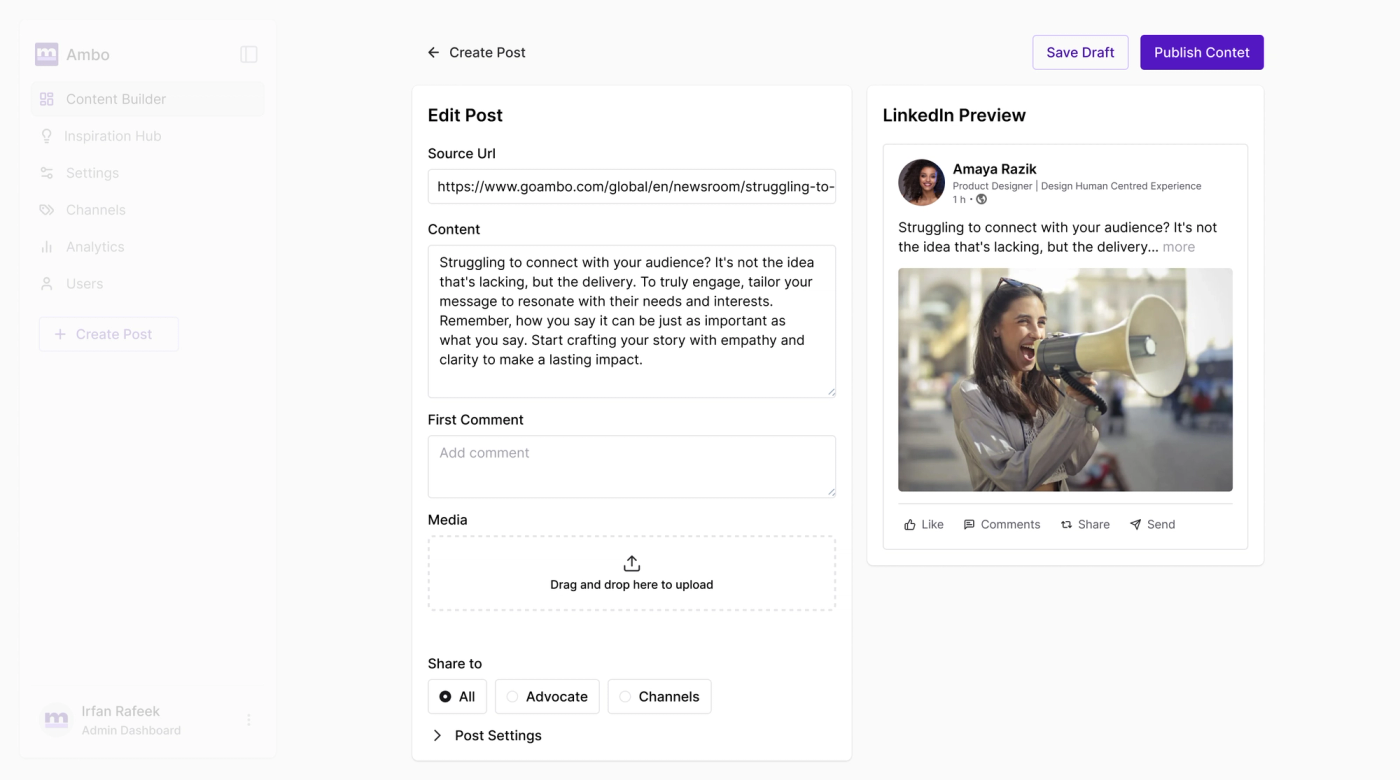
The initial product was intentionally simple:
- One post
- One schedule
- One audience group
If the same announcement needed to be shared differently with another audience, it had to be created as a completely new post.
As the product matured, the platform needed to support:
- Multiple variations grouped under a single post, with shared analytics and settings
- Different audiences and contexts
- Flexible scheduling
- Reposts
- AI-assisted writing
Each capability solved a genuine customer need. Together, they transformed a simple publishing flow into a sophisticated editorial workflow.
Solving the Biggest Friction Points
Rather than redesigning in one go,I focused on the problems users encountered most frequently.
Everyone Posted at the Same Time
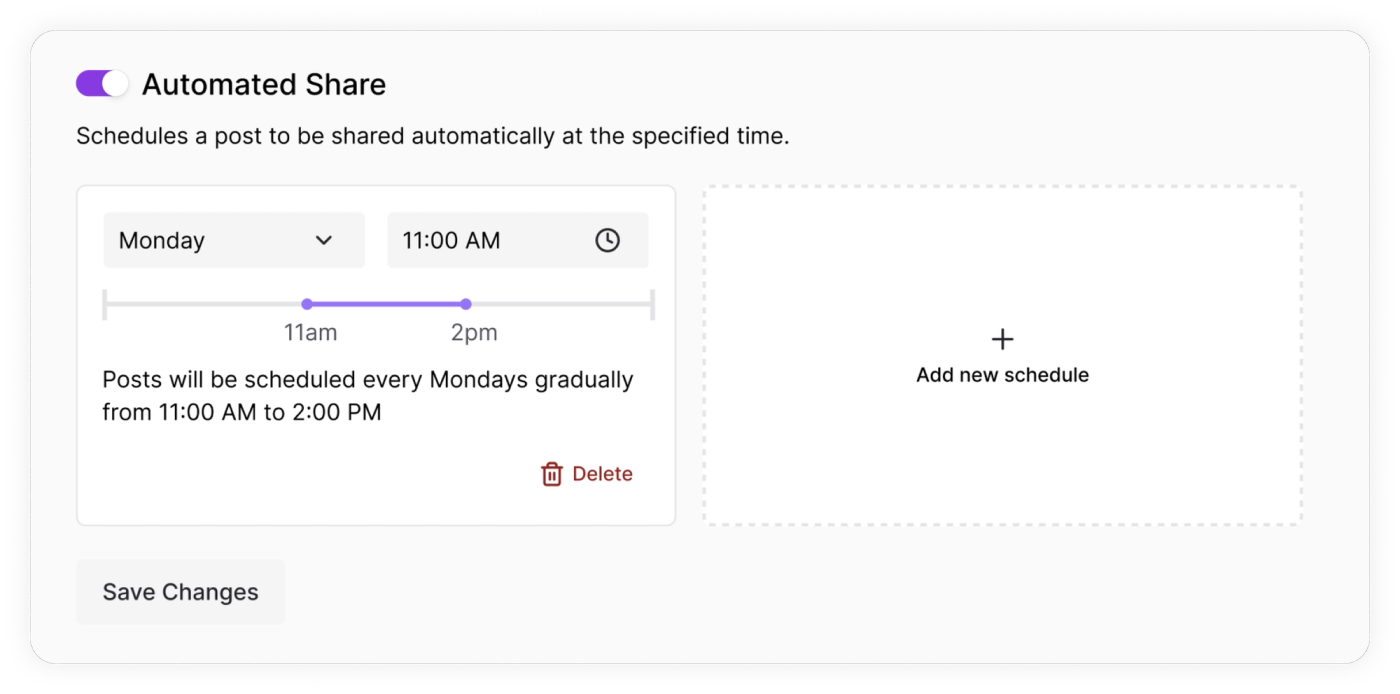
One of the first issues appeared in automated sharing. Every automated advocates published their content at nearly the same time.
While technically correct, the result felt unnatural. Feeds quickly became filled with identical posts appearing within minutes of each other.
To make distribution feel more organic, I explored multiple scheduling models before introducing distribution windows. Instead of publishing at a fixed time, posts are now spread naturally across a configurable time range.
Giving every advocate their own voice
The second challenge was authenticity. Every advocate shared exactly the same message.
Marketing teams wanted sales, product, leadership, and executives to communicate the same announcement, but in their own tone.
Supporting this meant rethinking the content model itself.
A single post now needed to support:
- Multiple content variations
- Reposts
- Individual scheduling
- Shared global settings
What initially sounded like a feature request quickly became an interaction design problem.
Exploring the Right Workflow
Since no established interaction pattern existed for this type of editorial workflow, I explored three fundamentally different models using Figma Make.
Each prototype was evaluated against three questions:
- Would it scale?
- Would it feel fast?
- Would users feel confident using it?
(Workflow A, B and C here)
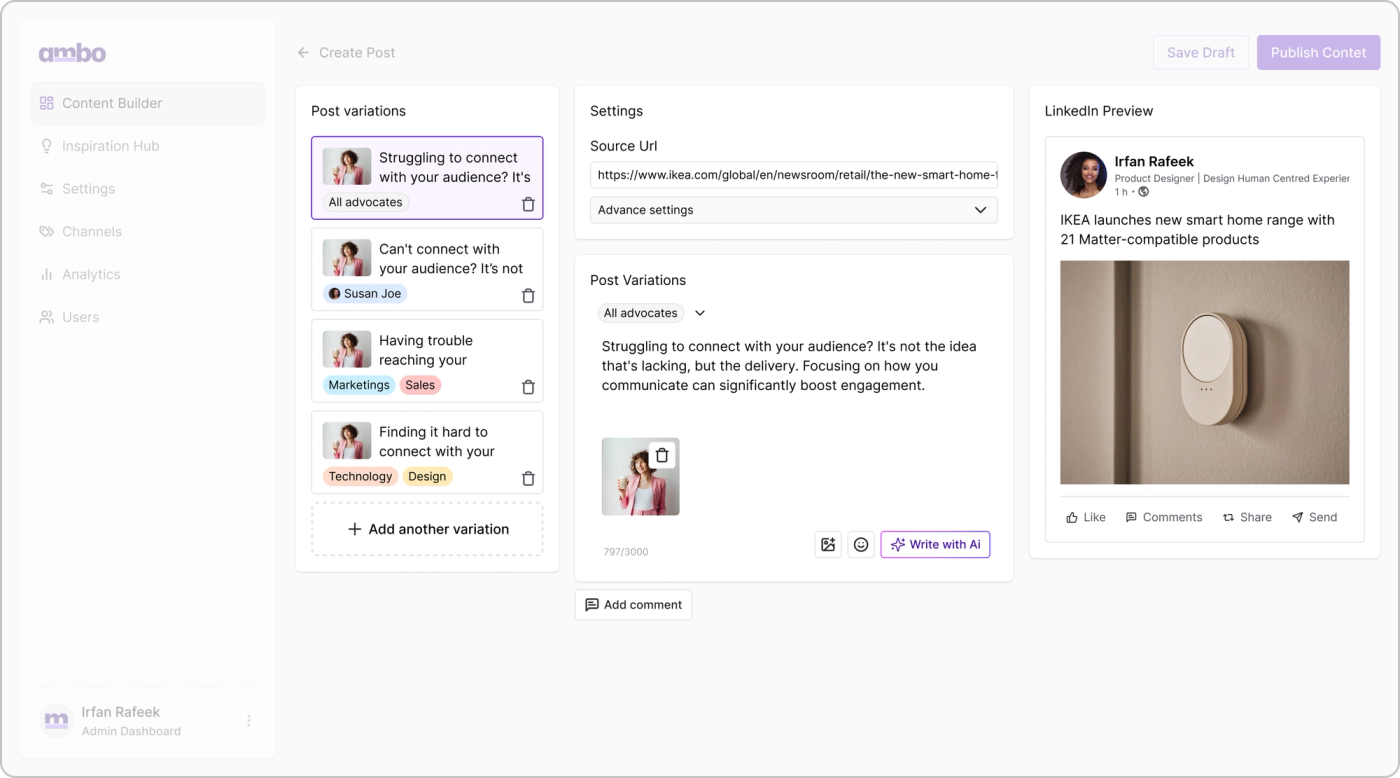
Workflow A
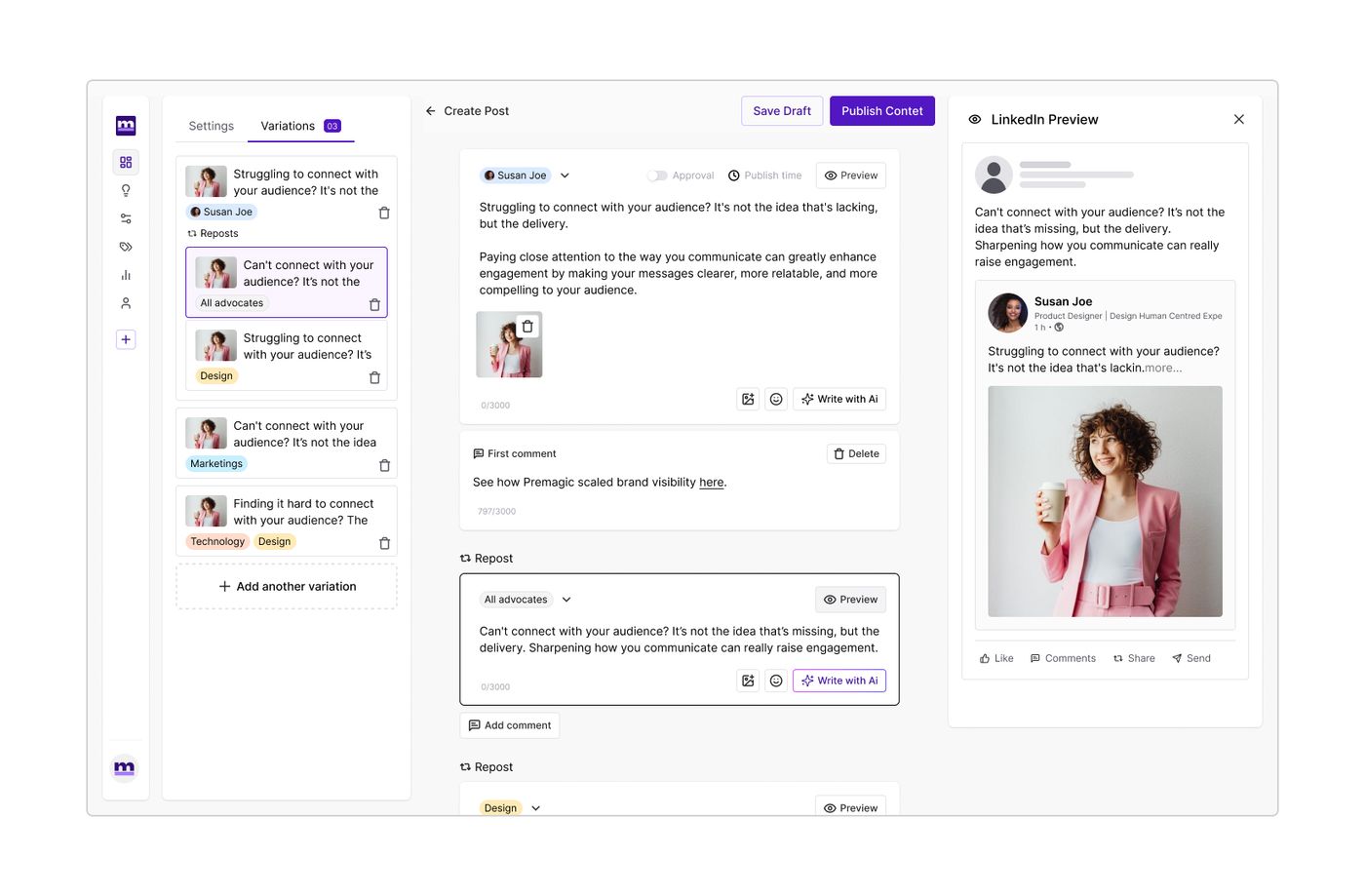
Variations as a First-Class Sidebar followed by edit post and separate preview.
Strengths
- Fast switching between variations
- Faster work flow
- Scales well as more metadata/features are added
Weakness
- Hierarchy between global settings and variations is less obvious
- Does not scale well when settings increase
- 3-column layout can feel intimidating
- Source URL sits close to variation editor
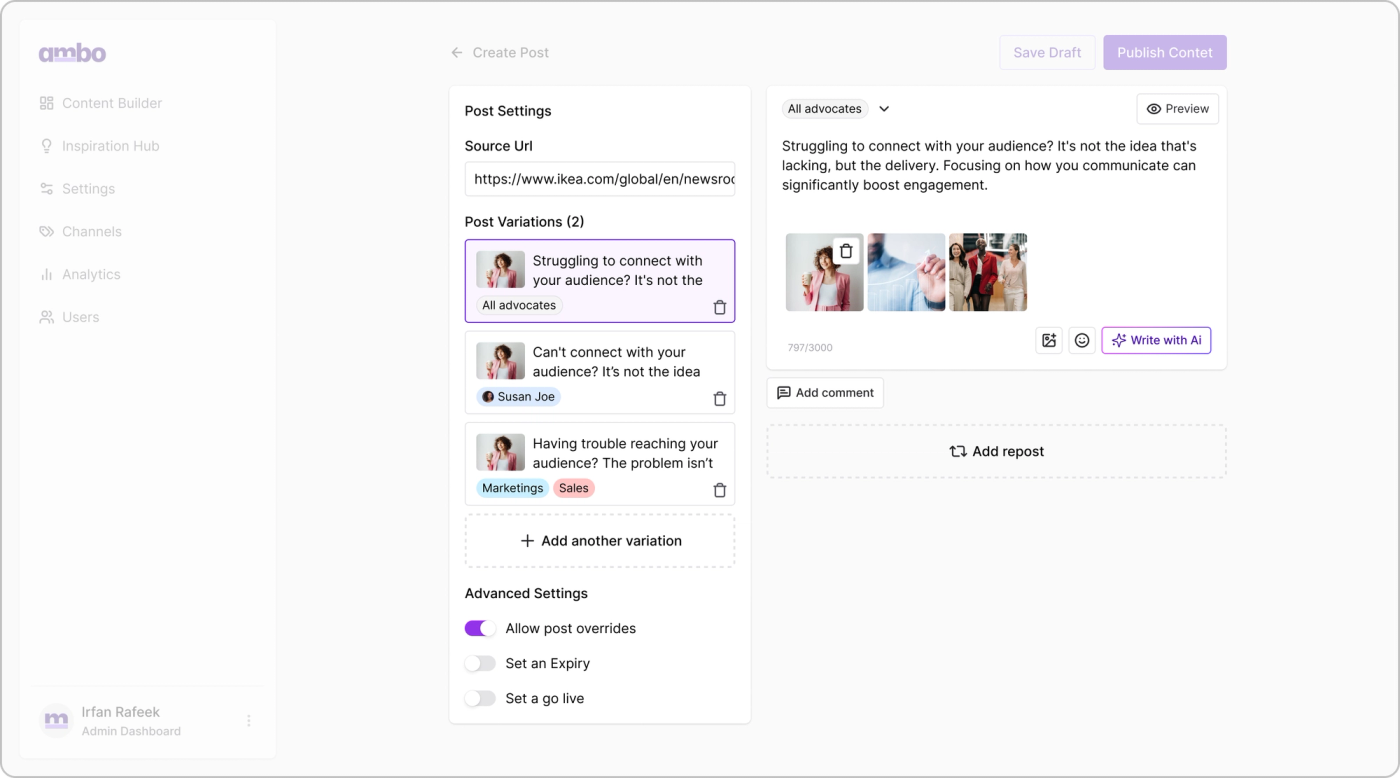
Workflow B
Variations Inside Post Settings and preview and edit post as switchable units.
Strengths
- Very clear hierarchy (settings → variations)
- Easier for new users to understand
Weakness
- Does not scale well when settings/variations variations increase
- Hard to scan
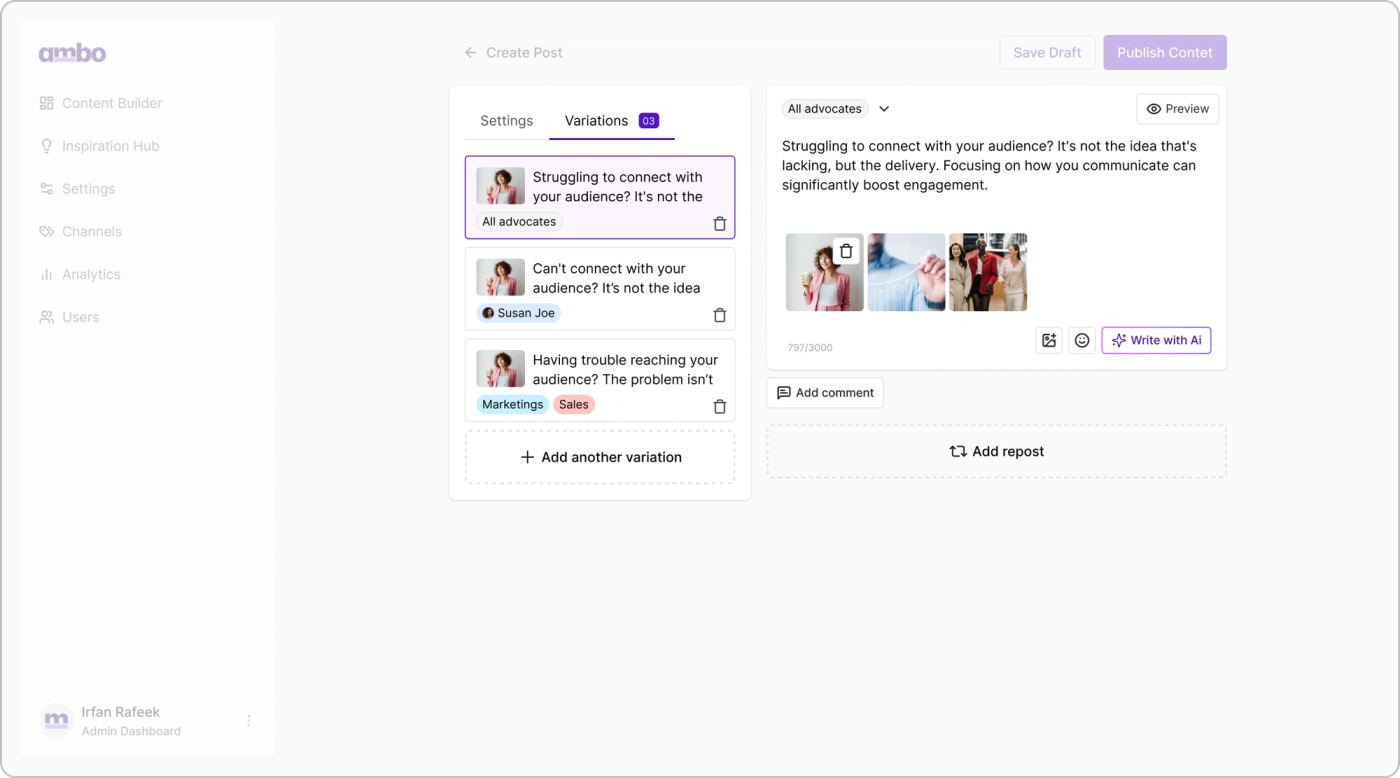
Workflow C
Variations Inside Post Settings and preview and edit post as switchable units.
Strengths
- Clean separation between global and variation settings
- Familiar interaction pattern
Weakness
- Users must remember context
- No simultaneous visibility
Final Workflow
Workflow C ultimately emerged as the strongest long-term direction.
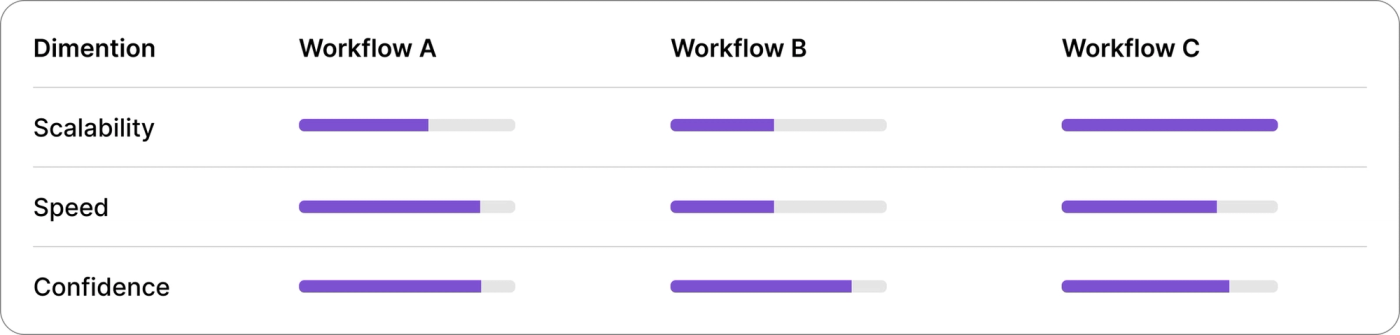
While it sacrificed a small amount of immediate visibility, it provided the clearest information architecture, stronger interaction hierarchy, and a scalable mental model for future editorial capabilities.
Refining the Authoring Experience
Like most early-stage startups, Ambo embraced a "ship it, then make it better" philosophy. Speed was the priority, so the first version of the product was built primarily using Chakra UI components, enabling the team to validate ideas and iterate quickly.
What started as a simple form had evolved into a fragmented workflow supporting variations, scheduling, reposts, and richer publishing needs..
Rather than continuing to Chakra UI components, I redesigned the experience around how marketing teams naturally create content. I introduced a set of purpose-built components for drafting, media management, variation management, and progressive disclosure, anchored by a WYSIWYG editor that closely mirrored the final published post.
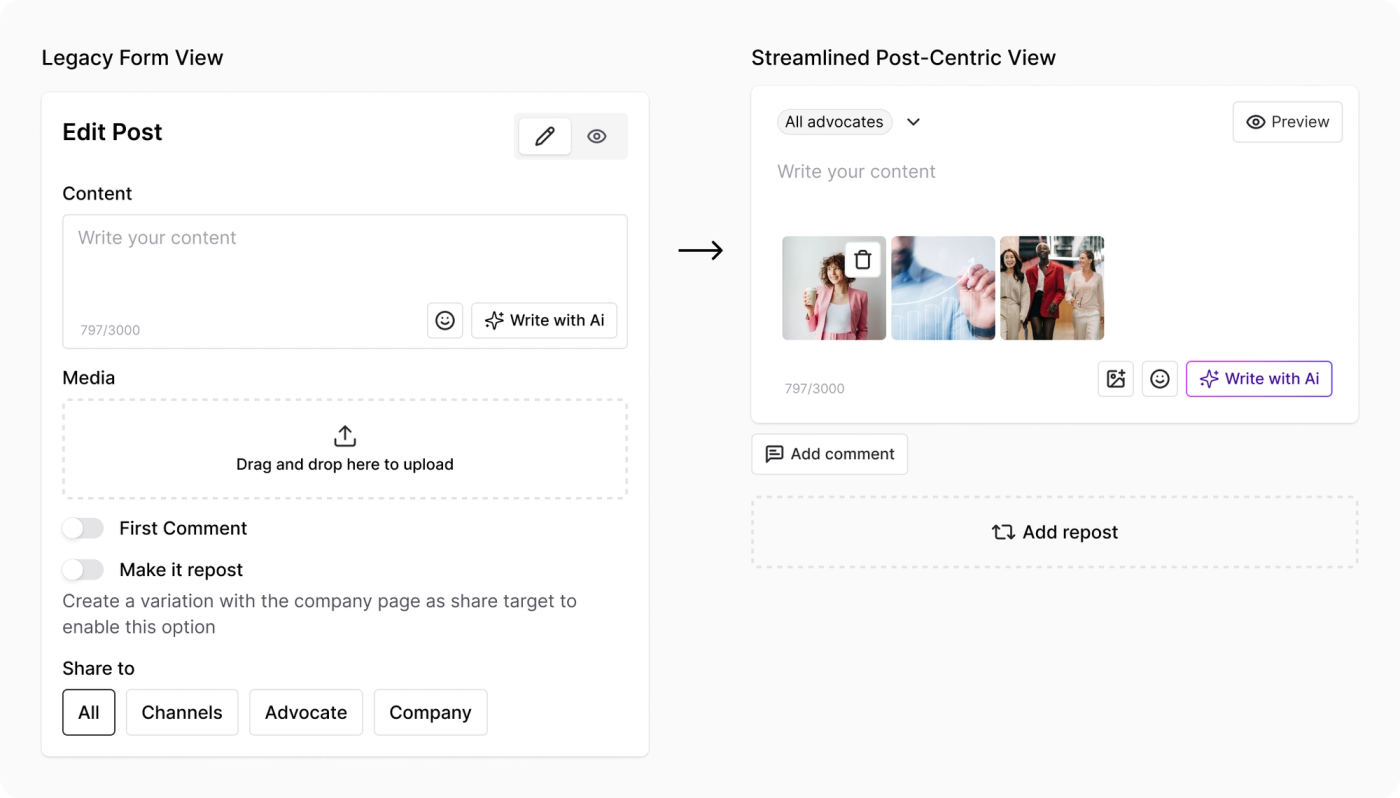
- Write in Context: Replaced disconnected form fields with an editor that mirrors the final post, allowing users to create content with confidence.
- Progressive Complexity: Reduced cognitive load through progressive disclosure, surfacing advanced capabilities only when they became contextually relevant.
- Content Before Configuration: Shifted the interface from managing settings to creating content, integrating media and publishing actions into a more natural authoring flow.
Integrating AI into editorial workflows.
As we observed how admins created content, one behaviour became increasingly clear, many relied on AI to draft and refine their posts. To support this, we initially introduced AI writing, allowing users to generate alternative versions of their content. The AI was also optimised for LinkedIn, adapting its suggestions to the intent and tone of the message being communicated.
While useful, the workflow still had friction. Users could generate multiple suggestions, but turning those into reusable post variations required several manual steps.
I explored multiple interaction models before redesigning the experience so AI-generated suggestions could be converted directly into content variations with a single click. Instead of copying and editing text manually, admins could select the versions they liked and instantly add them as ready-to-use variations.
Rather than introducing another standalone AI surface, the interaction model embedded AI directly into the existing authoring flow, preserving users mental model while reducing unnecessary context switching. Over time, it became one of the most frequently used features in the product.
Evolving the Editorial Workspace
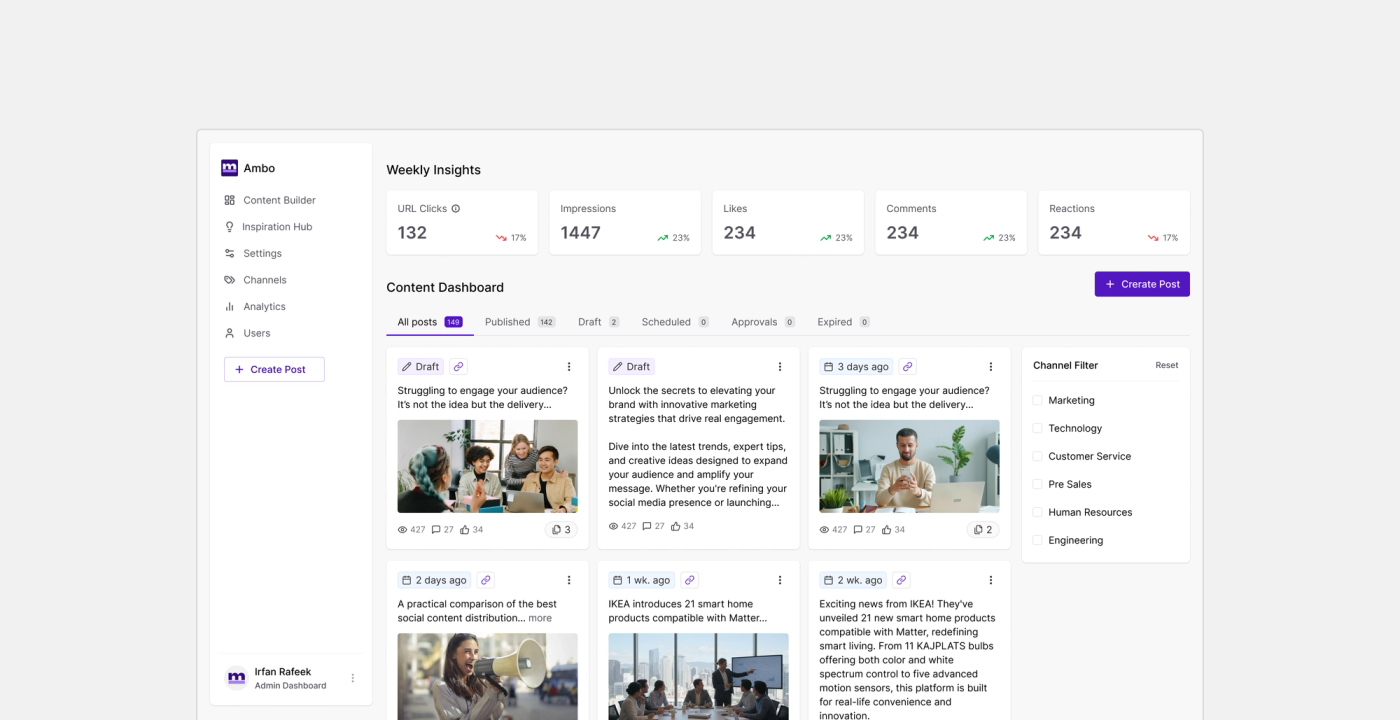
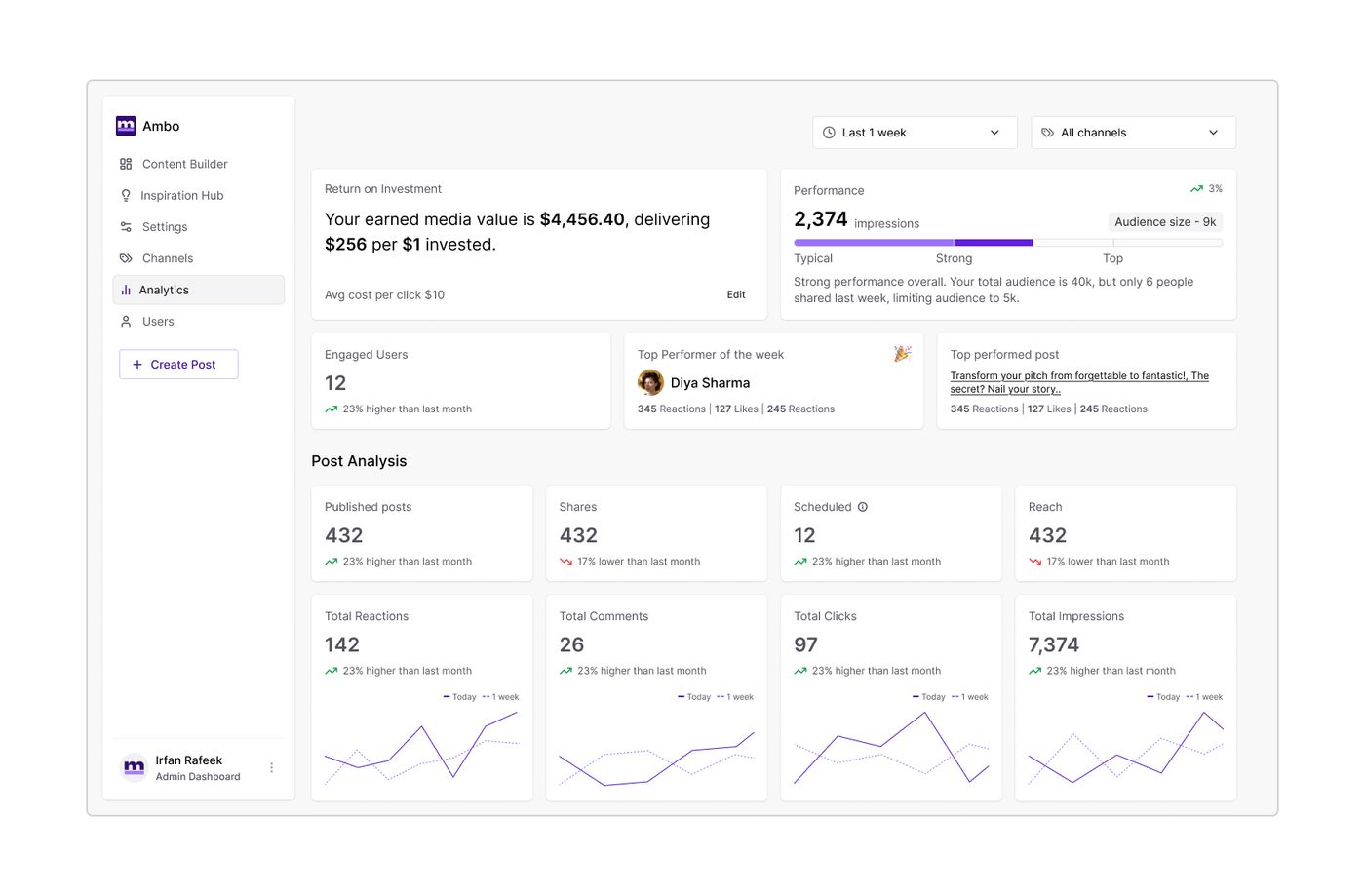
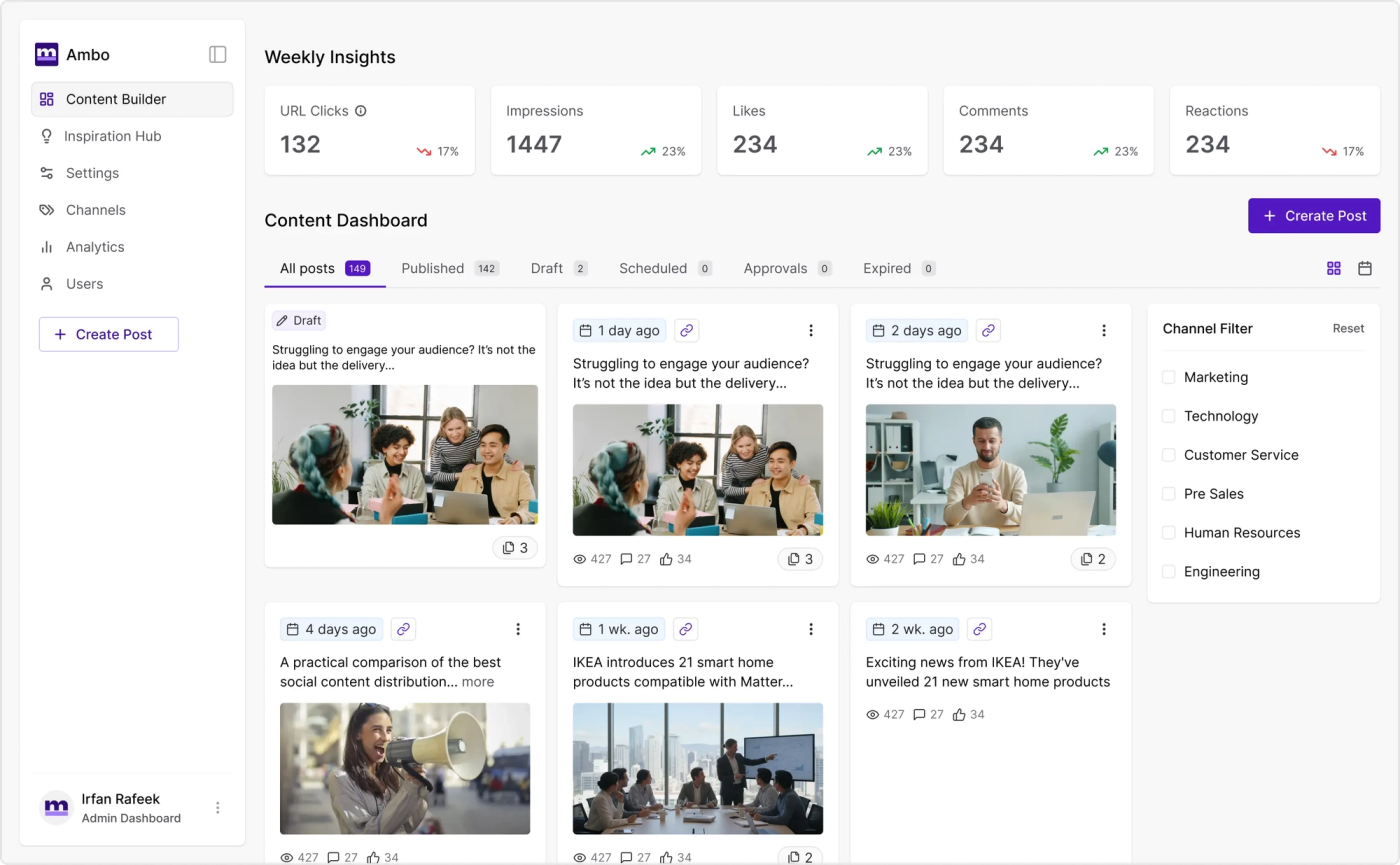
Creating content was only one part of the editorial experience. Once campaigns were published, teams needed to understand performance, monitor participation, and plan what came next. The dashboard evolved from a reporting interface into a decision-support workspace, improving information scent and bringing performance signals closer to the content they related to.
Performance Dashboard
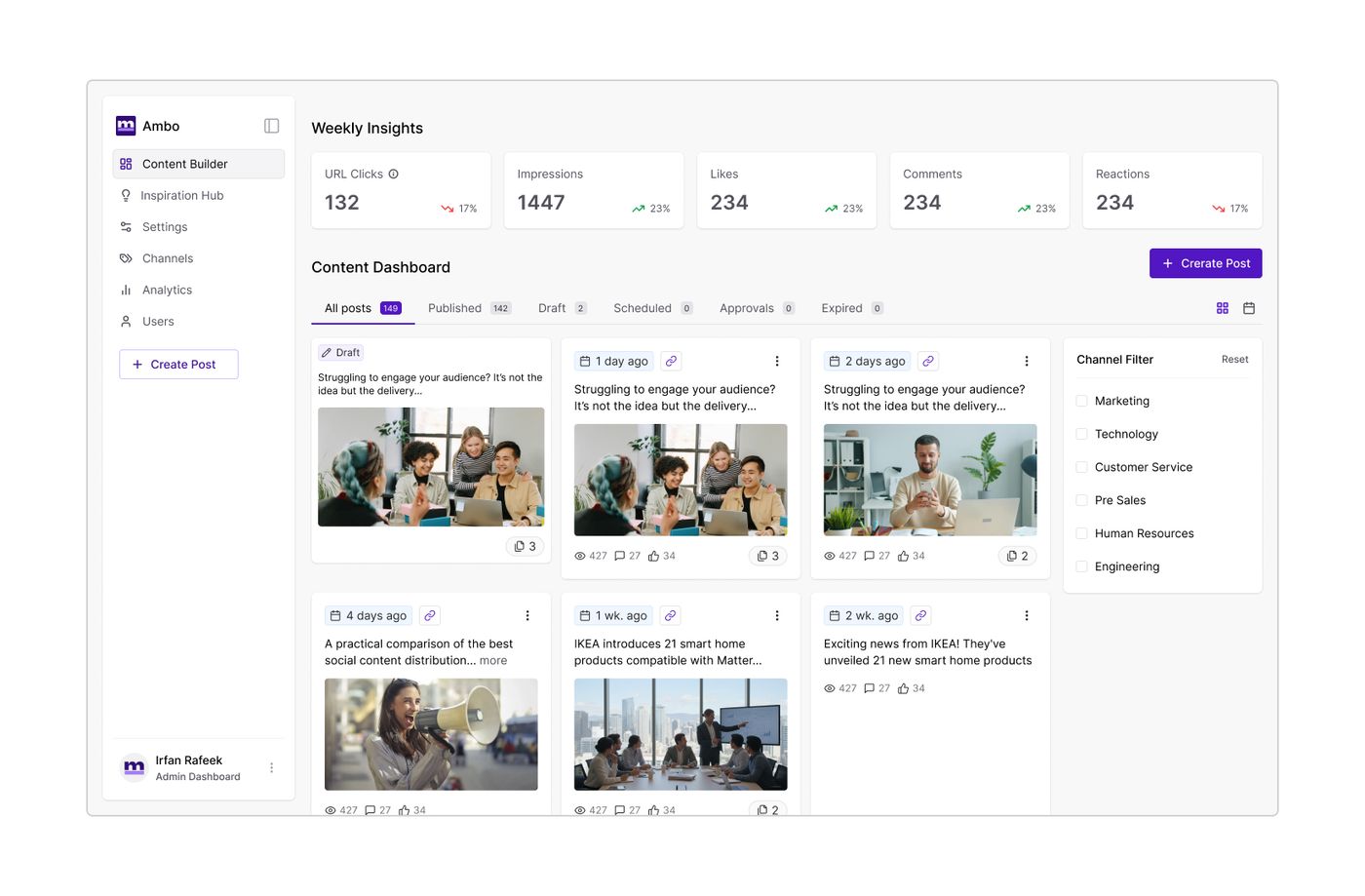
Performance signals such as shares, impressions, and clicks became part of the content feed itself, helping teams understand campaign performance without leaving their workflow.
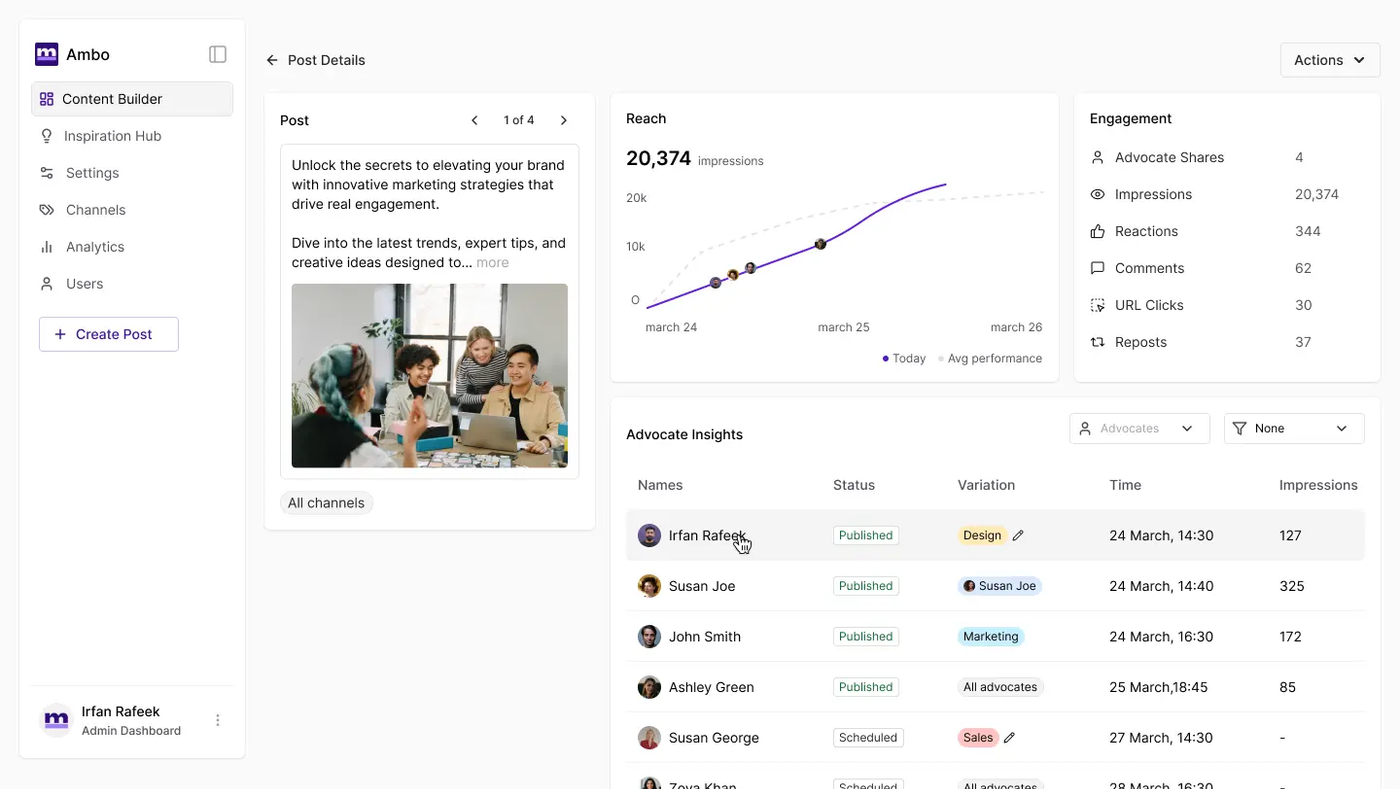
Post Details
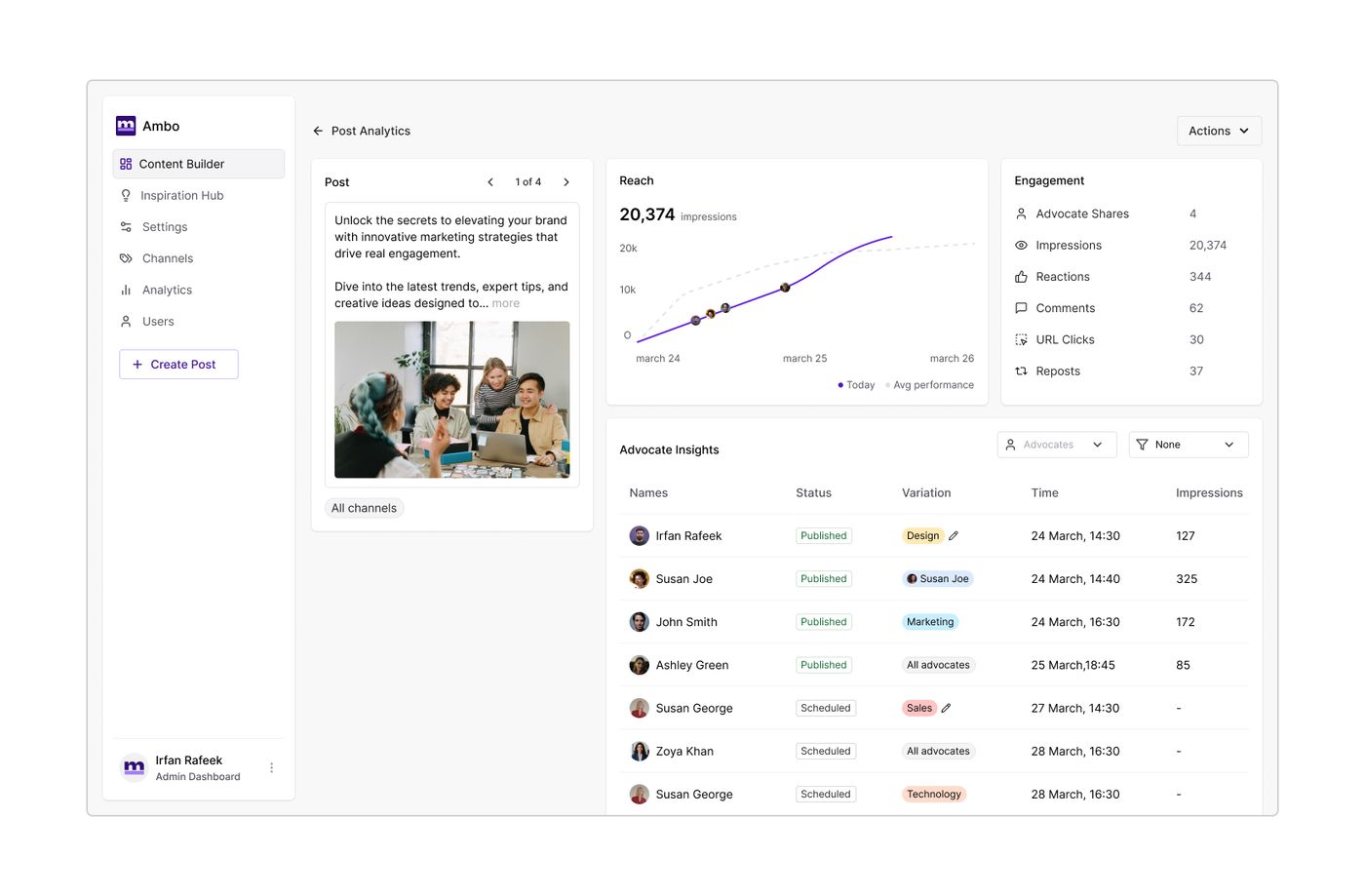
A dedicated post details page brought together reach, engagement, advocate participation, and campaign activity into a single workspace, allowing teams to monitor performance without jumping between multiple pages.
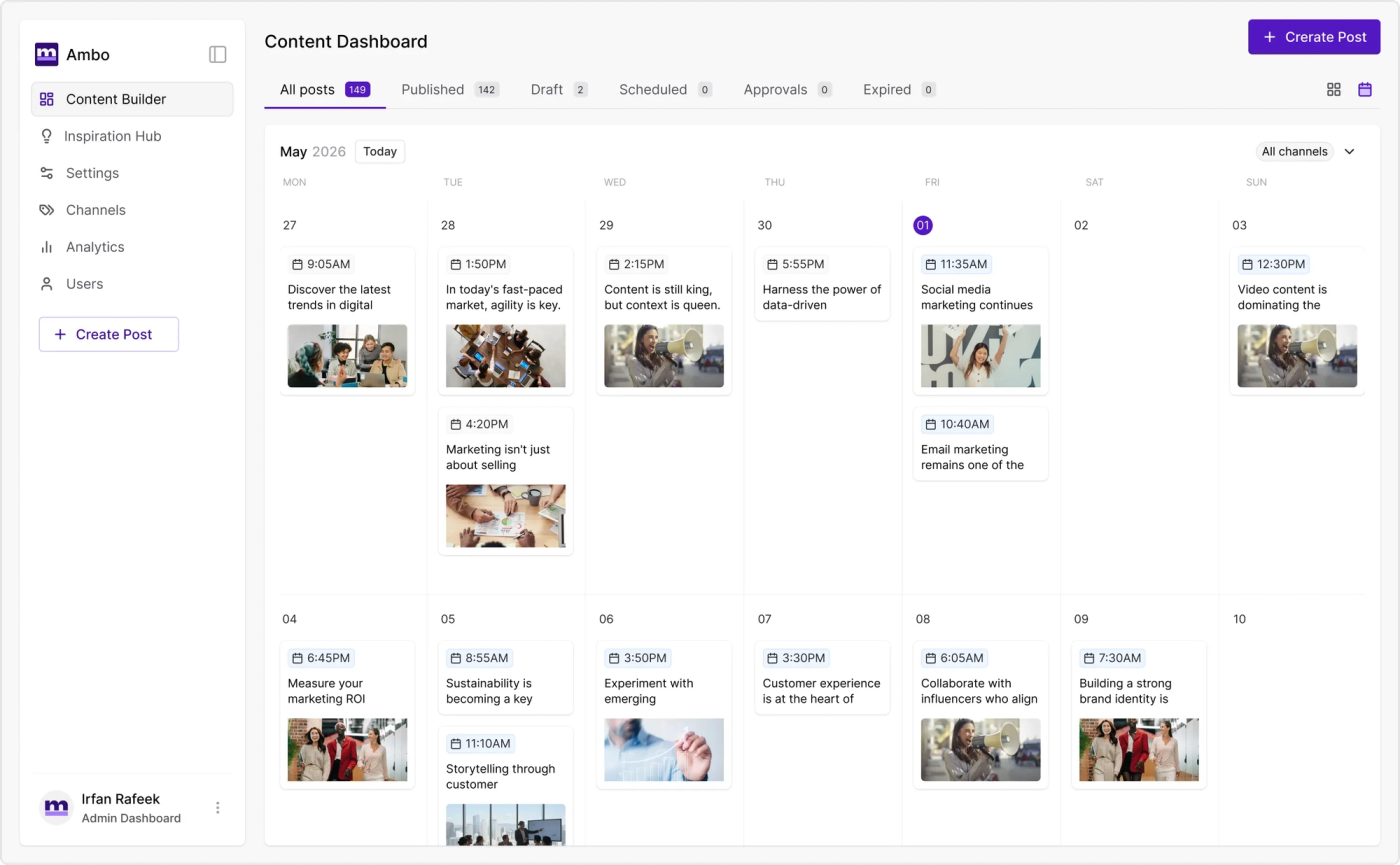
Calendar View
A calendar view transformed content management from a static list into a planning experience, making publishing cadence and scheduling conflicts immediately visible.
Outcome & Impact
As Ambo evolved, the challenge wasn't designing the next feature, it was ensuring the editorial experience became more powerful without becoming more complicated.
By rethinking the content model, simplifying the information architecture, and redesigning the interaction patterns around how marketing teams naturally create content, we transformed a collection of disconnected capabilities into a cohesive editorial workflow. Rather than exposing every capability upfront, the experience used progressive disclosure, stronger visual hierarchy, and reusable interaction patterns to support increasingly sophisticated publishing needs without overwhelming users.
Some key outcomes included:
- 40% improvement in content creation efficiency by integrating AI directly into core editorial workflows while maintaining user trust, transparency, and editorial control.
- Established a scalable editorial architecture supporting content variations, reposts, flexible scheduling, and future publishing capabilities within a unified interaction model.
- Improved discoverability, reduced cognitive load, and strengthened users' mental models by bringing content creation, publishing, and performance into a cohesive editorial experience.
- Created a flexible UX foundation that enabled new capabilities to be introduced without continually redesigning the authoring experience.
Looking back, the most valuable outcome wasn’t simply creating a seamless experience. It was establishing an editorial system that could evolve alongside the product. By investing in the underlying workflow architecture, interaction patterns, and information architecture, we created a foundation that could absorb increasing product complexity without compromising clarity or usability.
The result was an experience built not just for what Ambo needed today, but for how the product could evolve tomorrow.